





TECHWORLD D365 BES on Microsoft Platform: Rapid Deployment, Cost Optimization, and Operational Excellence
TECHWORLD D365 BES establishes an enterprise operating model on Microsoft Cloud, combining Business Central, Power Platform, and pre-built BES assets for controlled rollout, lower TCO, and measurable business outcomes.
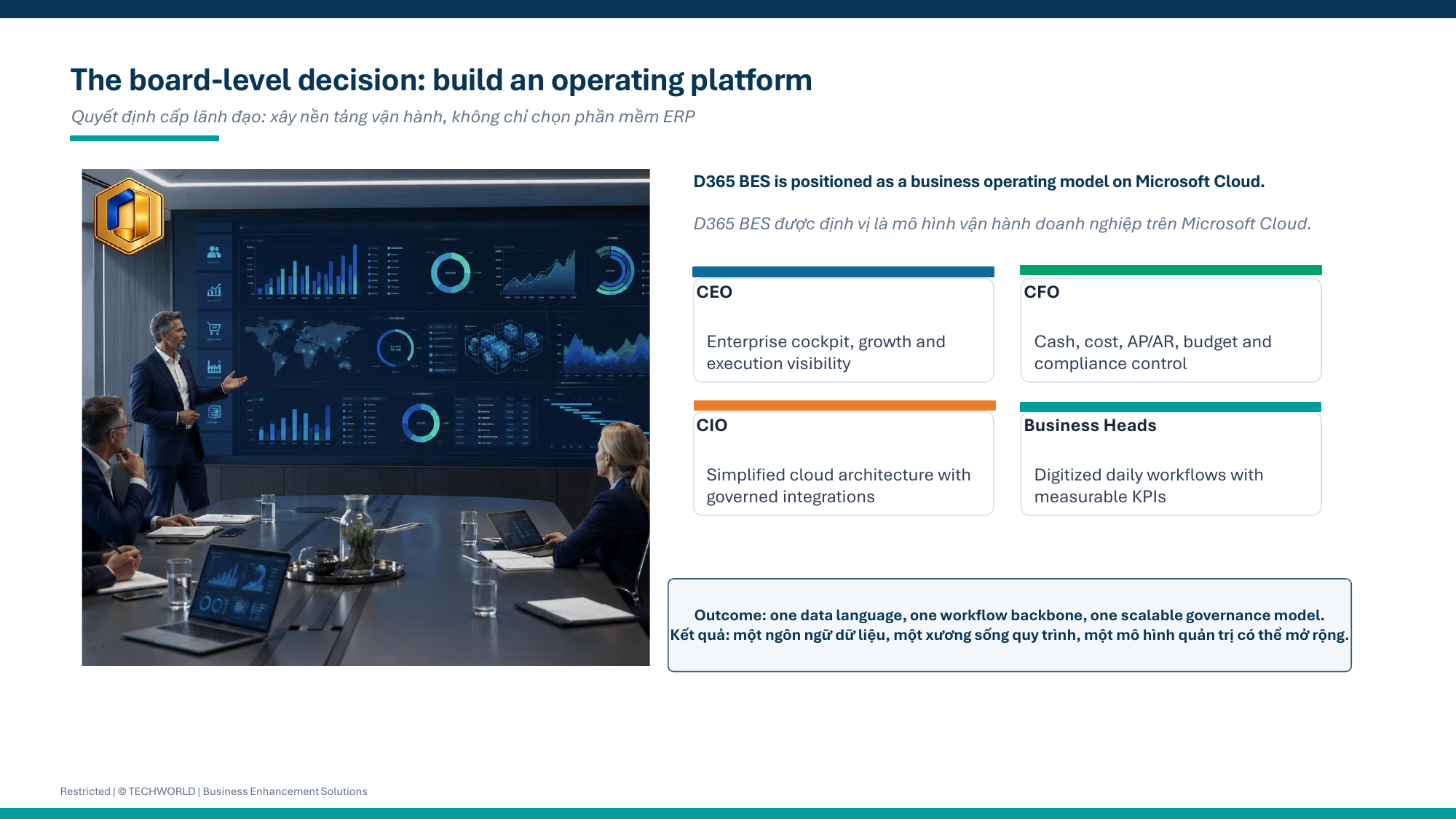
Executive Cockpit
End-to-end organizational visibility, tracking strategic growth, portfolio health, intercompany performance, and operational cadence.
Financial Control
Rigorous management over liquidity, cost-to-serve, AP/AR workflows, budget-versus-actual variance, and audit compliance trails.
Governed Architecture
Streamlined cloud landscape, unified identity, enterprise-grade security, governed API integrations, and extensible Power Platform capabilities.
Operational Execution
Digitized day-to-day workflows, accurate inventory, reliable service delivery, transparent cross-functional ownership, and clear KPIs.
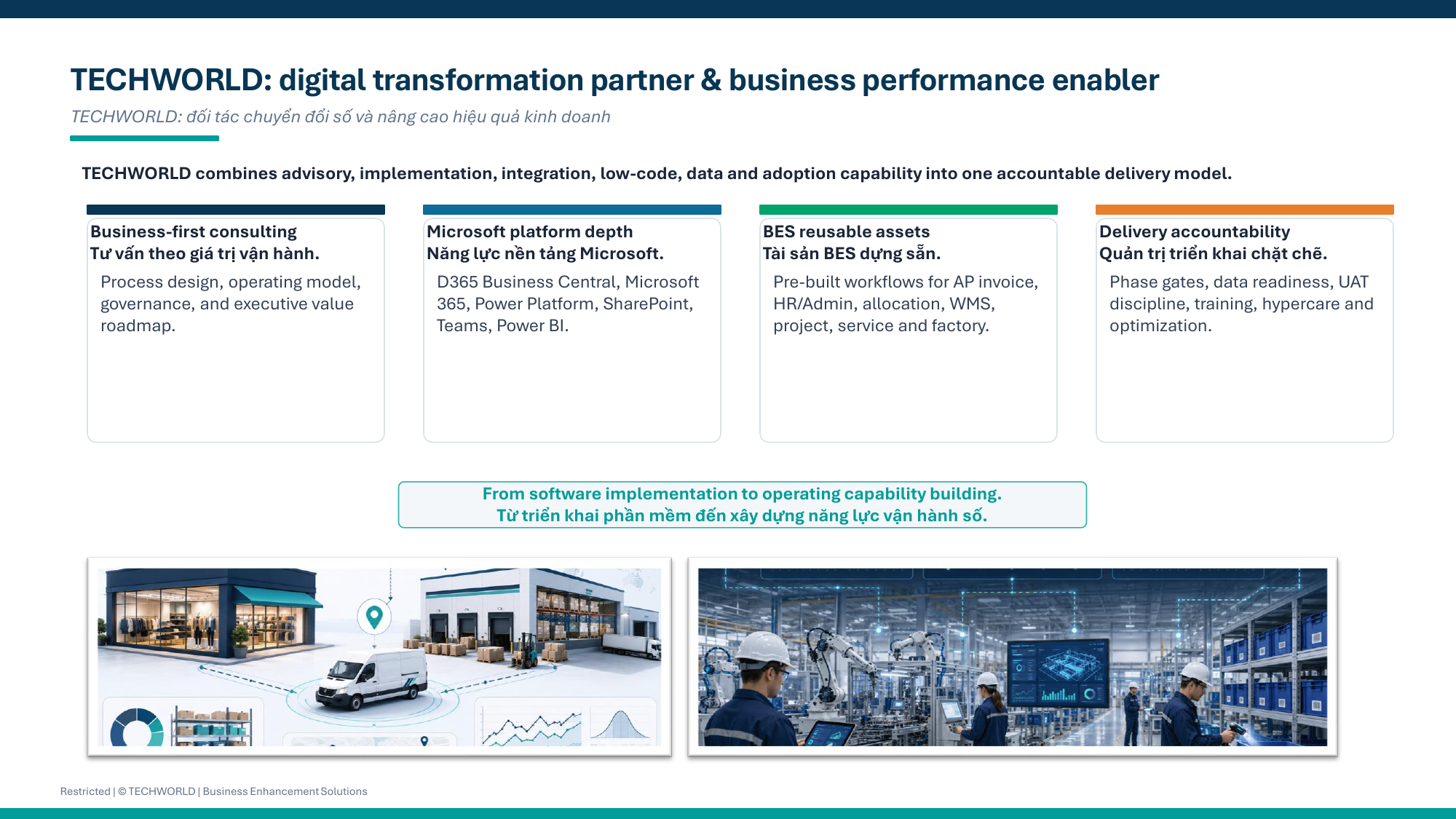
Business-First Consulting
Process re-engineering, target operating model design, governance frameworks, and executive value realization roadmaps.
Microsoft Platform Depth
Deep platform mastery: Dynamics 365 Business Central, Microsoft 365, Power Platform, SharePoint, Teams, and Power BI.
BES Reusable Assets
Pre-configured operational assets for AP invoice automation, HR/Admin, expense allocation, mobile WMS, project, service, and plant operations.
Delivery Accountability
Disciplined stage-gate governance, data readiness validation, structured UAT cycles, role-based enablement, and dedicated hypercare support.
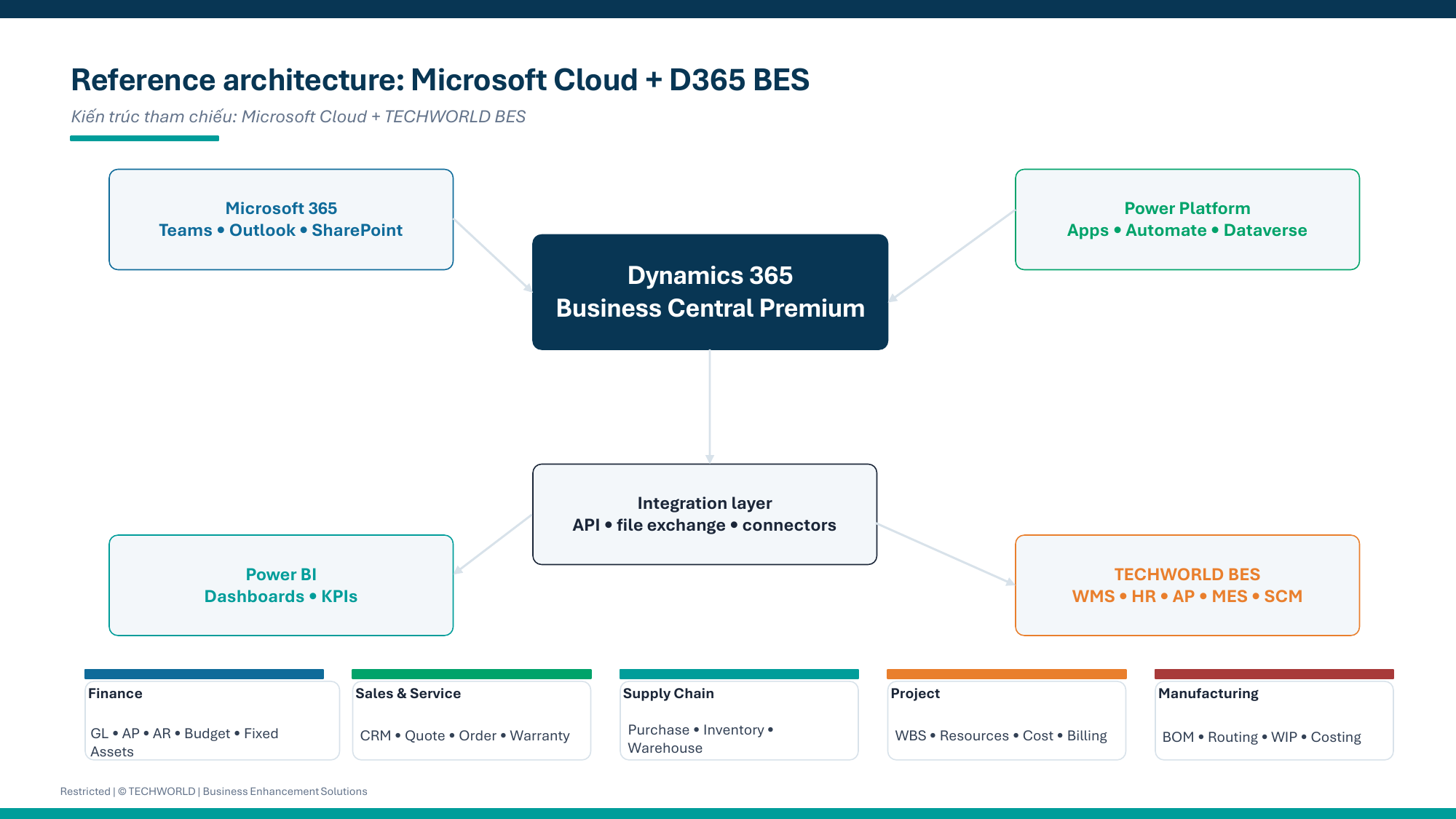
Standard Core ERP
Dynamics 365 Business Central Premium
Unified governance: Finance (GL, AP, AR, Budget, Fixed Assets), Sales & Service (CRM, Quote, Order, Warranty), Supply Chain (Purchase, Inventory, Warehouse), Project Management (WBS, Resources, Cost, Billing), and Manufacturing (BOM, Routing, WIP, Costing).
Modern Workplace & Low-Code
Microsoft 365 & Power Platform
Native collaboration via Teams, Outlook, and SharePoint. Power Apps, Power Automate, and Dataverse empower rapid low-code form creation and agile approval workflows.
Extensions & Connectivity
TECHWORLD BES & Integration Layer
Modular BES packages for WMS, HR/Admin, AP automation, MES, and SCM, backed by governed APIs, certified connectors, and secure file exchange protocols.
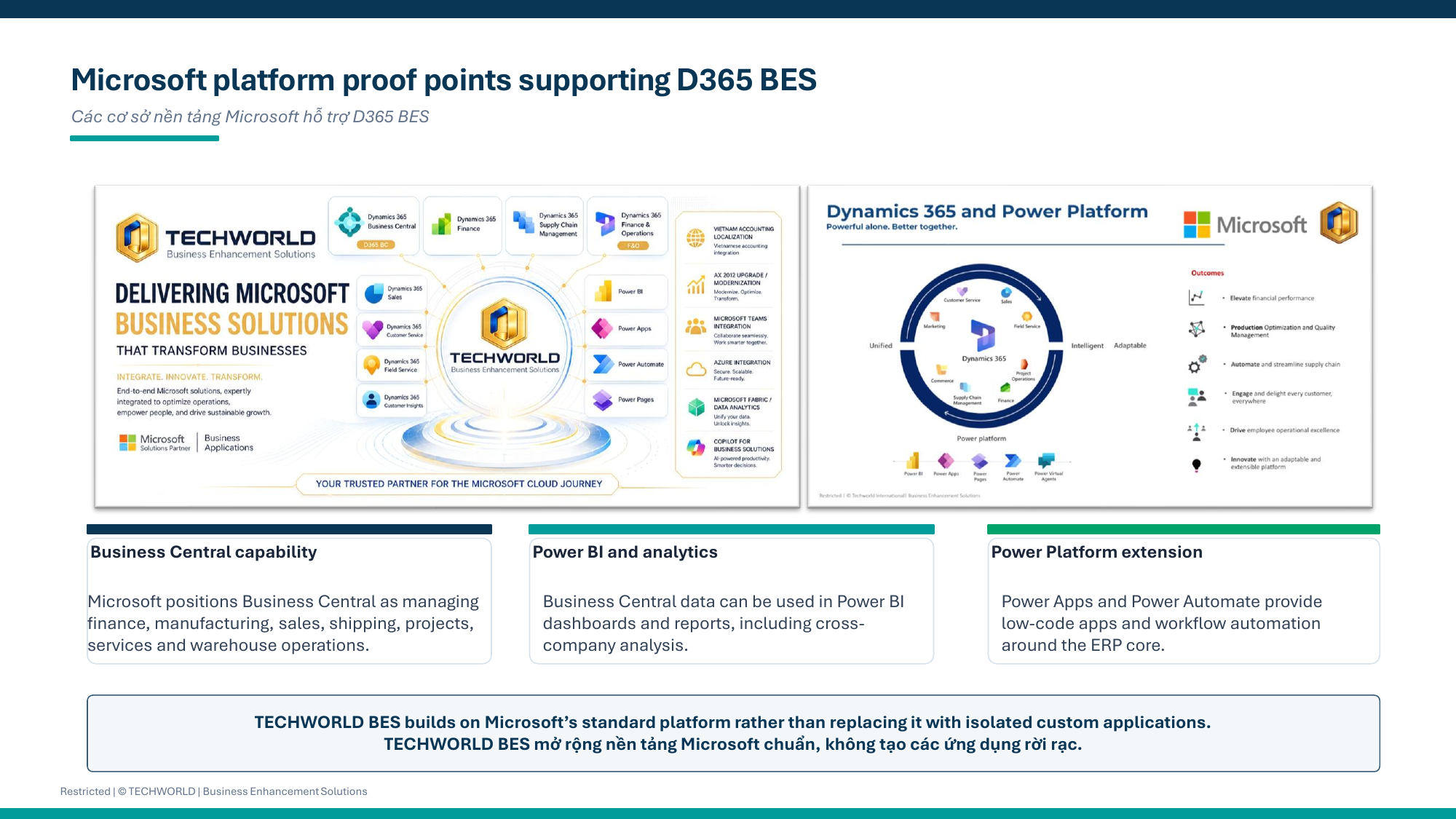
Business Central Capabilities
Globally trusted core functionality covering finance, manufacturing, distribution, warehousing, project accounting, and field service operations.
Power BI & Analytics
Seamlessly surfaces Business Central transactional data into executive dashboards, enabling real-time cross-company visibility and faster decisions.
Power Platform Extension
Power Apps and Power Automate deliver fast, secure low-code applications and digital workflows surrounding the core ERP without modifying base code.
| Decision Factor | D365 BES Strategic Direction | Typical Risk in Large ERP Programs |
|---|---|---|
| Time-to-Value | Launches priority value streams early and expands via pre-built BES assets. | Protracted blueprinting and analysis phases delay visible operational benefits. |
| User Adoption | Leverages familiar ergonomics of Microsoft 365, Teams, Excel, and Power BI. | Heavy change resistance caused by unfamiliar UI and complex navigation patterns. |
| Cost Control | Phased wave-based roadmap coupled with modular low-code extensions. | Escalating customization expenditures and deep vendor/integrator lock-in. |
| Multi-Entity Rollout | Native multi-company ledger, flexible dimensions, and automated intercompany transactions. | Rigid template-heavy rollouts that slow local subsidiary buy-in and agility. |
| Extensibility | Governed extensions through Power Platform, REST APIs, and modular BES layers. | Intrusive code alterations that complicate, delay, and inflate recurring upgrade costs. |
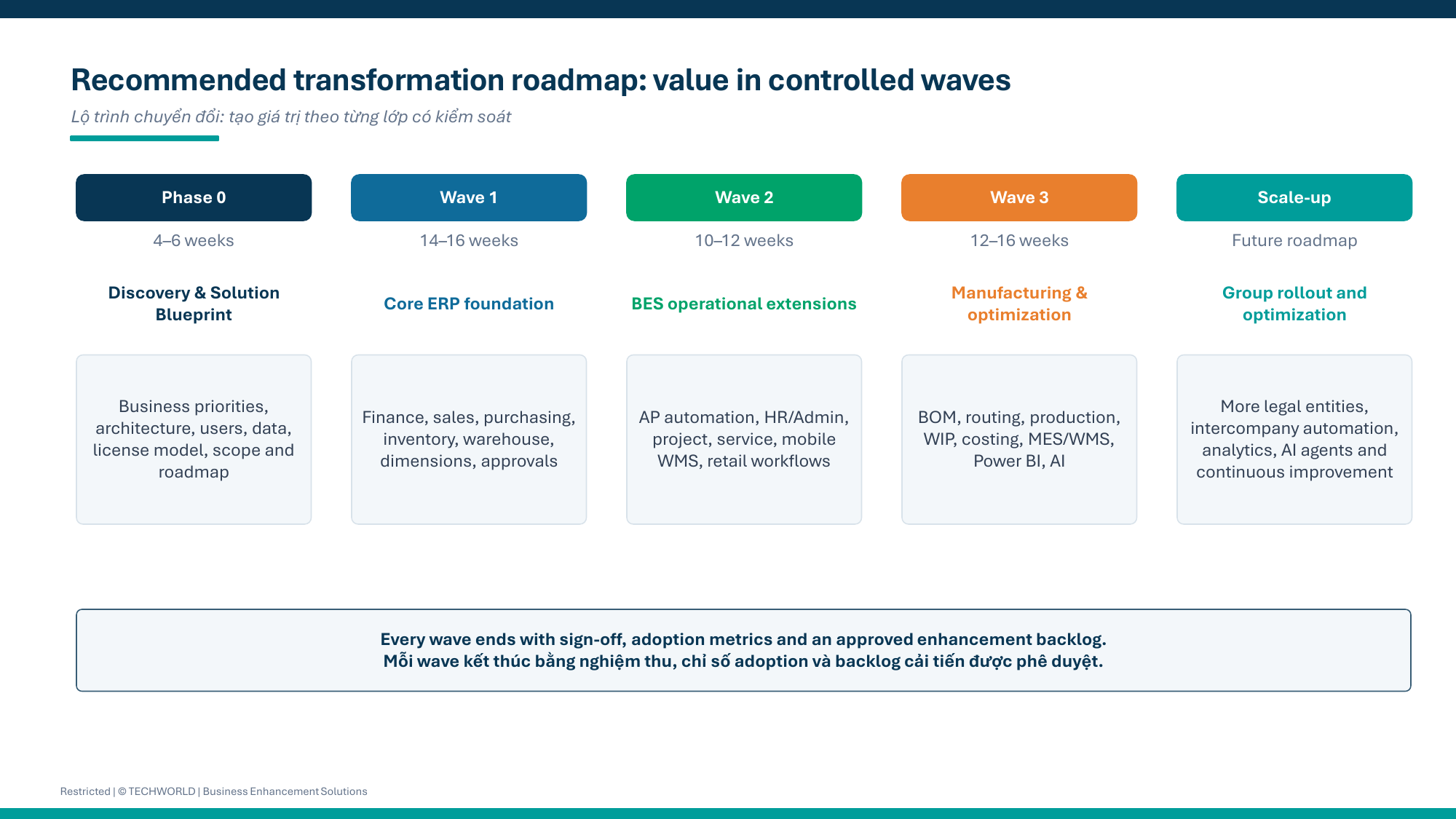
4 – 6 weeks
Discovery & Solution Blueprint
Alignment on business priorities, technical architecture, user licensing models, data readiness standards, scope boundaries, and roadmap execution.
14 – 16 weeks
Core ERP Foundation
Operationalizing core capabilities: General ledger, AR/AP, sales order processing, procurement, inventory management, warehouse baseline, dimensions, and approval hierarchies.
10 – 12 weeks
BES Operational Extensions
Deploying AP automation, HR/Admin modules, project resource tracking, customer service management, mobile barcode WMS, and retail workflows.
12 – 16 weeks
Manufacturing & Advanced Optimization
Configuring BOMs, production routings, shop-floor work orders, WIP tracking, product costing, MES/WMS synchronization, advanced Power BI reporting, and AI capabilities.
Future Roadmap
Group Rollout & Governance
Onboarding additional legal entities, enabling intercompany transaction automation, deploying predictive AI agents, and maintaining a continuous backlog of enhancements.
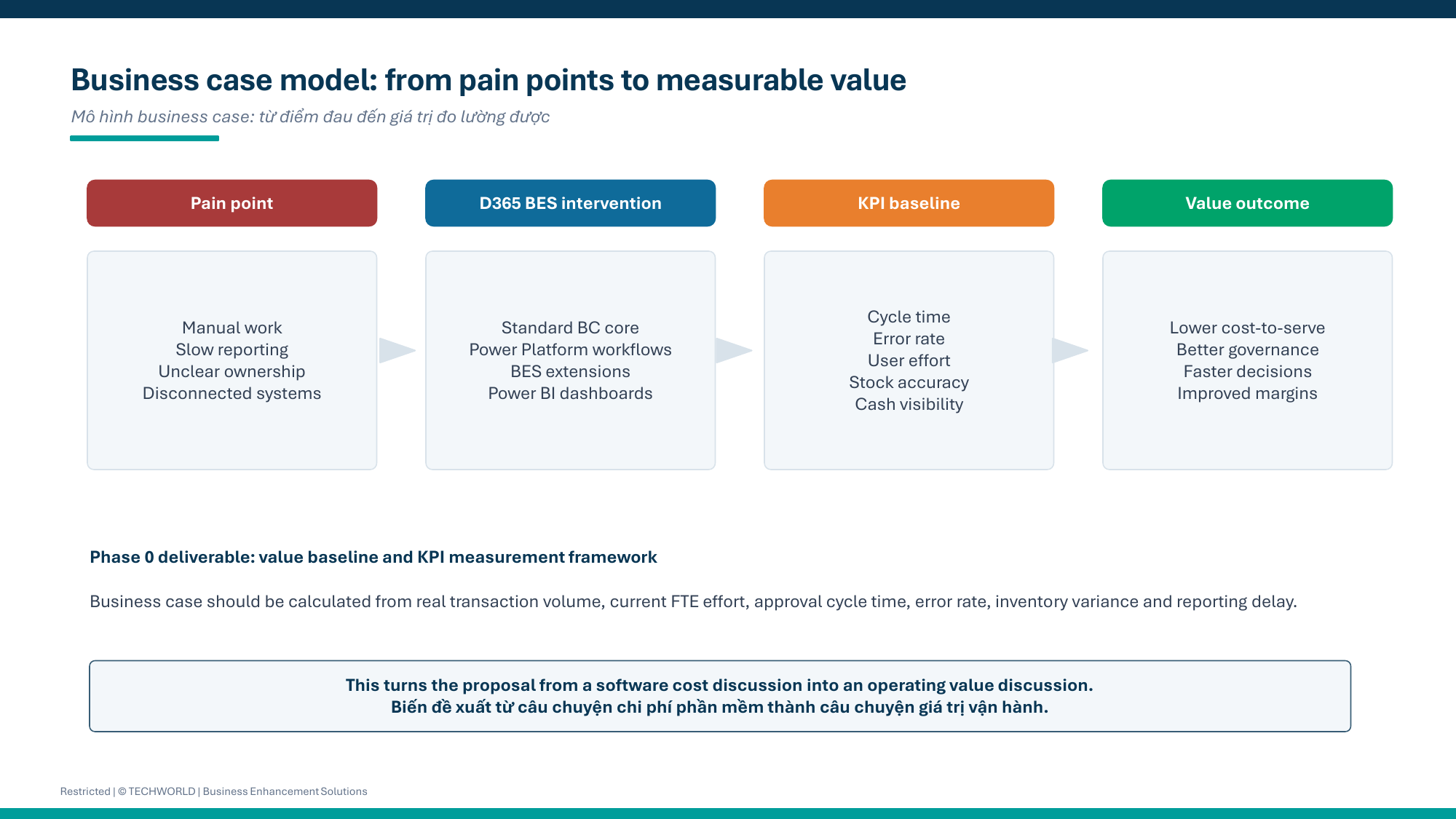
Key Operational KPI Baselines
- Cycle Time: Drastic reduction in end-to-end document processing and multi-level approval cycles.
- Error Rate: Elimination of manual transcription mismatches and departmental data discrepancies.
- User Effort: Relieving operational teams from repetitive administrative tasks to focus on strategic execution.
- Stock Accuracy: Real-time visibility into inventory levels, transit states, and warehouse allocations.
- Cash Visibility: Instantaneous transparency over working capital, cash flow forecasting, and budget variance.
Quantifiable Value Outcomes
- Lower Cost-to-Serve: Streamlined execution costs per customer order and vendor transaction.
- Better Governance: Clean data lineage, enforced segregation of duties, and frictionless auditability.
- Faster Decisions: Live, automated management dashboards replacing delayed manual reporting spreadsheets.
- Improved Margins: Shrinkage reduction, strategic supplier consolidation, and tighter project margin controls.

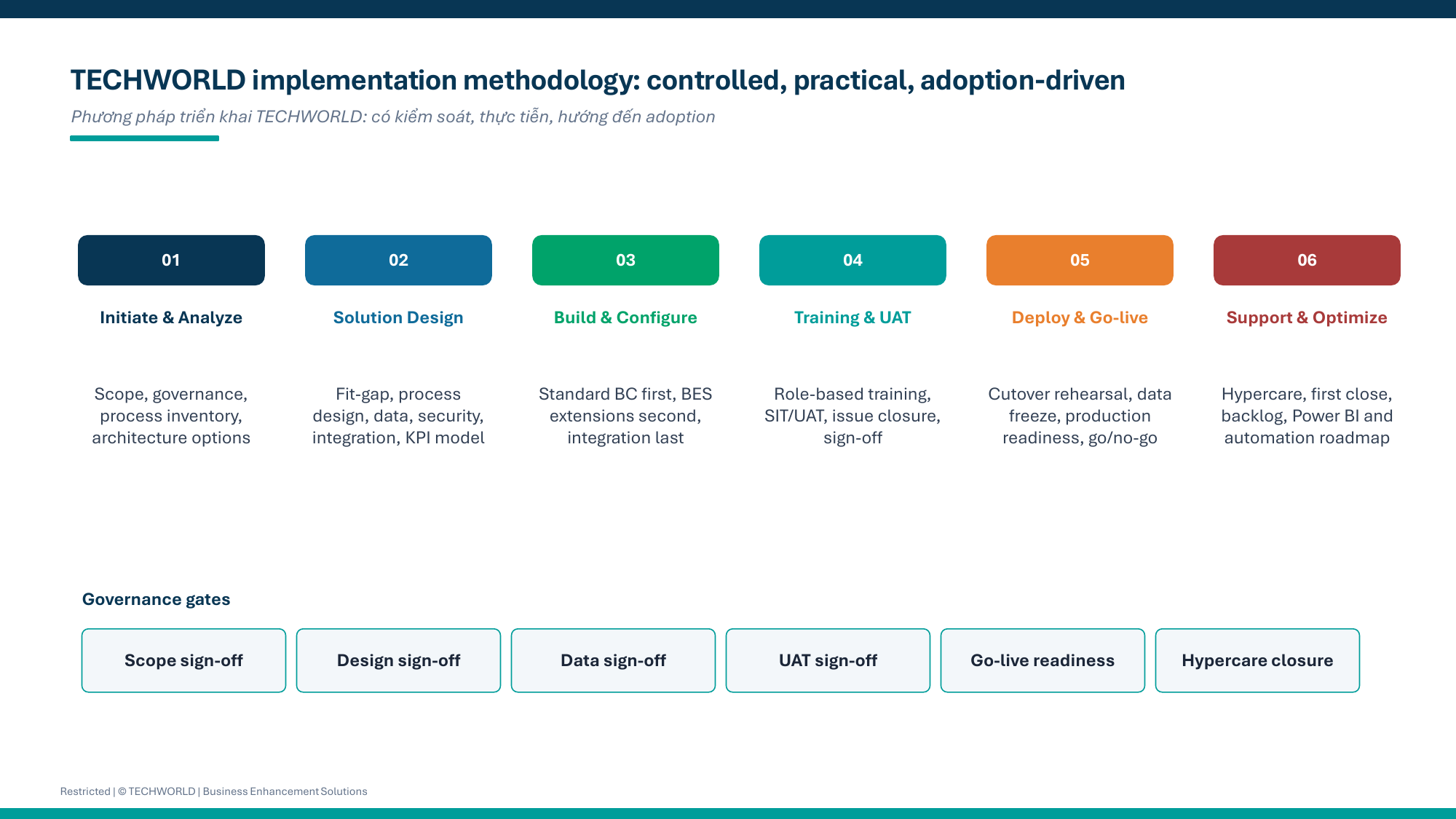
Initiate & Analyze
Project kick-off, establishing governance cadence, detailed business process inventory, and evaluating core architectural options.
Solution Design
Fit-gap analysis, target process mapping, master data structures, role-based security matrices, integration specs, and the KPI framework.
Build & Configure
Executing the golden rule: Standard Business Central first, BES extensions second, integration connectors last.
Training & UAT
Role-based user training, system integration testing (SIT), structured user acceptance testing (UAT), issue remediation, and sign-off.
Deploy & Go-live
Cutover rehearsal, transactional data freeze, opening balances validation, production readiness gate, and formal go/no-go approval.
Support & Optimize
Intensive hypercare support, successful first financial period close, backlog prioritization, Power BI refinement, and long-term automation planning.
Six Disciplined Governance Gates
Growing Mid-Market & Enterprises
Companies aiming to institutionalize standardized operational controls while avoiding the prohibitive expense and complexity of legacy ERP giants.
Microsoft Ecosystem Users
Organizations with existing investments in Microsoft 365, Teams, and Power BI looking to establish a unified operational data layer without jarring UX shifts.
Multi-Entity & Diversified Groups
Businesses operating across distribution, trade, services, or manufacturing that require automated intercompany consolidation and clear operational transparency.
1. What is D365 BES?
D365 BES is an enterprise operating platform developed by TECHWORLD on Microsoft Cloud, utilizing Dynamics 365 Business Central as the transactional core and enriched with Microsoft 365, Power Platform, Power BI, and pre-built BES modules.
2. How does D365 BES differ from traditional ERP projects?
While retaining comprehensive ERP capabilities, D365 BES is positioned as an agile business operating platform. TECHWORLD unites ERP transactions, modern collaboration, low-code automation, and real-time business intelligence under a single governance model.
3. Can we implement individual modules independently?
Yes. Organizations can prioritize specific business modules based on immediate operational urgency and deploy them across controlled waves. All components adhere to standard data architecture, guaranteeing future scalability.
4. How natively does D365 BES connect with Microsoft 365 and Power BI?
D365 BES provides out-of-the-box native integration with Microsoft 365, Teams, Outlook, SharePoint, Dataverse, and Power BI, alongside an integration layer of REST APIs, connectors, and managed file exchanges for external third-party systems.
5. What is the typical deployment timeline for D365 BES?
Our reference roadmap outlines 4–6 weeks for Phase 0 discovery and blueprinting, followed by 14–16 weeks for the core ERP foundation, and subsequent waves for advanced capabilities. Formal timelines reflect actual data readiness, system scope, and resource alignment.
6. Why does D365 BES optimize total cost of ownership (TCO)?
By prioritizing standard Business Central capabilities, leveraging pre-configured BES assets, extending through low-code Power Platform tools, and executing in phased waves, the solution curbs excessive customization risks and minimizes long-term maintenance overhead.